Opensee is the AI-native data management and analytics platform trusted by leading banks, asset managers, and hedge funds to govern, explore, and analyze billions of data points with speed, precision, and control. Our mission is to democratize financial data and analytics, enabling any analytics, on any data, at any scale, for any human or AI agent.
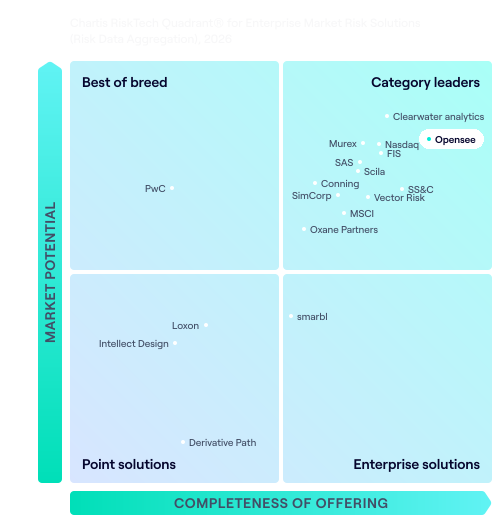
A risk data aggregation platform brings risk data from across a financial institution into a single, governed source, so teams can calculate and analyze at any level of detail and produce accurate, traceable reports. Opensee, the leader in Chartis' 2026 RiskTech Quadrant for risk data aggregation, adds a financial semantic layer that makes AI reliable on this data, and Agensee, Opensee's agentic AI, which turns it into answers and automated workflows.
Opensee sits on top of a firm's existing pricing and valuation libraries, rather than replacing them, bringing all data into a single model that can be explored down to an individual trade. Opensee's disk-based, massively parallel engine runs fast analytics on very large risk datasets at a lower infrastructure cost than in-memory alternatives. The platform is open by design, working with Excel, BI tools, Python, and APIs. Opensee is also the only vendor in Celent's 2027 Financial Risk Solutions for Capital Markets report to have demonstrated a control mechanism over the actions of autonomous AI agents.
Agensee, Opensee's AI, is reliable because of the foundation it runs on. Every metric, hierarchy, and regulatory calculation is defined once in a financial semantic layer, and data is quality-checked, certified, and versioned. The LLM works out what the user wants, then plans and orchestrates the steps, using these governed definitions first. When a question needs a calculation that doesn't exist yet, Agensee builds it from the governed data and metrics and writes it as explicit code you can inspect. Every number comes from executed code, never from the model's guess. Opensee's governed platform runs every calculation deterministically, on 100% of live production data, so every answer respects user permissions and can be reproduced, traced back to source, and audited.